

How to Start Journaling When You’ve Never Done It Before

You do not need a beautiful notebook, a morning routine or something profound to say. You only need somewhere to begin.
There is something slightly intimidating about the first page of a new notebook. It is completely empty, which somehow makes it feel as though whatever you write there should be worth keeping. Maybe you have seen other people's journals filled with beautiful handwriting, thoughtful reflections, little drawings and pages that look as though someone carefully composed them before putting pen to paper. Then you sit down with your own notebook and think: What am I actually supposed to write?
If you have never journaled before, this is probably the most important thing to know: there is no correct way to do it. You do not have to write every morning, document your entire day or use special prompts. You do not need perfect handwriting or a notebook expensive enough to make you afraid of ruining it. A journal can simply be a place where some of the things in your head get to exist somewhere else for a while. And you can start with one sentence.
First, forget what a journal is supposed to look like
The word journaling can make something very ordinary sound like a practice you need to learn. But people have been writing things down for themselves for a very long time: thoughts, lists, observations, complaints, memories, questions, things they want to remember and things they cannot stop thinking about.
Your journal does not need to resemble the ones you see online. It does not need carefully coordinated pens or decorated pages, and it does not need to become a record of your personal growth. Nobody needs to read it, including your future self. You are allowed to cross things out, abandon a sentence halfway through, write three lines today and nothing for two weeks, or write something completely boring. In fact, boring is a very good place to begin.
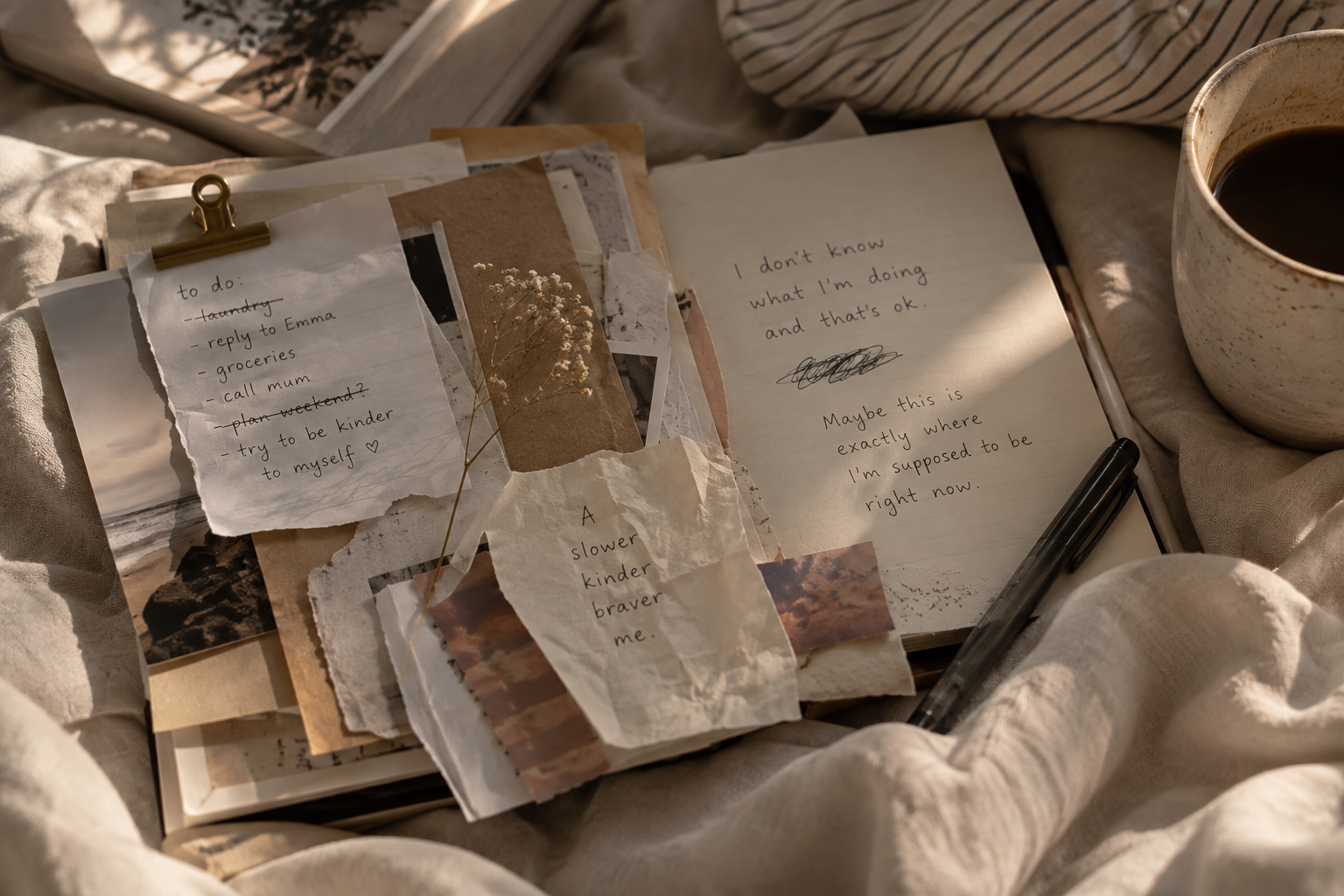
Choose a notebook you are willing to use
It is tempting to believe that buying the perfect notebook will turn you into someone who journals. Sometimes it helps: a notebook you genuinely like can make you want to pick it up. But there is a small danger in choosing something too beautiful. Suddenly every page feels precious. You hesitate before writing something messy, save it for important thoughts and tell yourself you will begin properly on Monday, on the first of the month or when you have figured out what your journaling routine should look like.
So choose something that feels nice but usable. A cheap notebook from the supermarket works, as does an old notebook with twenty unused pages at the back. A fancy journal works too, as long as you are willing to make mistakes in it. The best journal is not the most beautiful one. It is the one you are not afraid to write in.
A few things that make journaling a little nicer
You really don’t need much to start journaling. But if you’re looking for a notebook you’ll actually enjoy reaching for, a pen that feels good to write with or a few little extras, I’ve gathered some of my favourites below. Nothing essential — just lovely things that can make sitting down with your journal feel a little more inviting.
A few journaling favourites
Nothing essential, just a few lovely things that can make sitting down with your journal feel a little more inviting.
Dotted Journal
A simple dotted journal with plenty of space for thoughts, lists and everyday reflections.
Explore on Amazon →Everyday Journal
A lovely notebook for everyday journaling without making every blank page feel too precious.
Explore on Amazon →Gel Pens
Smooth gel pens that make sitting down to write feel just a little nicer.
Explore on Amazon →Journaling Stickers
A playful little extra for decorating journal pages, notes and reading lists.
Explore on Amazon →Creative Pens
For adding colour, highlights and small creative details to your journal pages.
Explore on Amazon →Journaling Accessories
A few extra details for making your journal pages feel a little more personal.
Explore on Amazon →This section contains affiliate links. As an Amazon Associate I earn from qualifying purchases.
Do not begin with “Dear Diary”
Unless you want to, of course. One of the hardest parts of journaling is often the first sentence, so remove the pressure to begin elegantly. Start with what is already happening:
It is Tuesday evening and I don't really know what to write.
I am sitting at the kitchen table waiting for my pasta to cook.
Today was strange.
I keep thinking about...
All of these count. You do not need an introduction because nobody has arrived halfway through the story. Your journal already knows where you are. Sometimes the most ordinary opening sentence leads somewhere unexpected, and sometimes it does not. Both are fine.
Start smaller than you think you should
If you decide that journaling means filling three pages every morning, there is a good chance your new habit will last approximately four mornings. Try five minutes instead, or one paragraph, or three sentences. You can even stop halfway down the page.
The purpose of starting small is not eventually to train yourself to write more. You may always prefer short entries. It simply makes beginning easier. Try finishing these three sentences:
Today I noticed...
Something I keep thinking about is...
Right now I feel like...
That is already a journal entry. You can close the notebook there.
Write about what actually happened
People sometimes sit down to journal and immediately feel as though they should begin examining their deepest thoughts. You do not have to. Start with your day—not necessarily a chronological account of everything you did, but the pieces that stayed with you.
What made you laugh? What annoyed you more than it should have? What did someone say that you are still thinking about? What did you eat? Where did you go? What was the weather like when you left the house? What song did you listen to repeatedly? What tiny thing would otherwise be completely forgotten a month from now?
Some of my favourite things to write down are precisely the things that seem too insignificant to record: the coffee that was unexpectedly good, a dog sitting seriously on the tram, the first evening warm enough to leave the window open, something ridiculous a friend said, a meal you want to make again or the way your neighbourhood smelled after rain. These details rarely feel important while they are happening. Later, they are often the parts that make a memory feel real.
Try writing what you cannot quite say out loud
A journal can also hold the less tidy things: the conversation you keep replaying, the decision you cannot make, something you are angry about but do not know whether you are allowed to be angry about, or a thought that feels too unfinished to explain to somebody else.
You do not have to make sense of it. Sometimes writing I don't know why this is bothering me so much is enough to begin. You can contradict yourself on the next page and change your mind tomorrow. A journal does not require you to arrive at a conclusion. It can simply hold the unfinished version.
If you don't know what to write, use a prompt
Prompts can be helpful when the blank page feels particularly blank, but you do not need a list of one hundred profound questions. Choose one that makes you immediately think of something.
What has been taking up more of my attention than I would like?
What has felt good lately?
What am I looking forward to?
What do I wish I had more time for?
What is something small I don't want to forget about this week?
What have I been avoiding?
What would make today feel a little nicer?
What am I currently curious about?
What is something I have changed my mind about recently?
What do I want less of right now?
You do not need to answer the question properly. A prompt is simply somewhere to enter the page. If your answer wanders into an entirely different subject, let it.
If prompts are the part of journaling you find most helpful, I’ve put together a longer list of ideas for the days when nothing seems to come to mind. You can find them in What to Write in a Journal When You Don’t Know What to Write.
Make lists when sentences feel like too much
Journaling does not even have to look like writing. A page can be a list: things you loved this month, things currently annoying you, meals you want to cook, books you want to find, things you heard someone say, places you want to revisit, things you are grateful you bought, songs you cannot stop playing, tiny things that made today better, things you want to stop pretending you enjoy or questions you do not know the answers to.
Lists are particularly useful on days when you want to write something but do not have the energy to turn your thoughts into paragraphs. They also become surprisingly interesting to rediscover later.
Leave evidence of your actual life
Your journal does not have to contain only words. Tape in the receipt from a dinner you loved, keep a train ticket, add the little paper tag from something you bought on holiday, press a flower between two pages, stick in a photograph, save a handwritten note someone gave you or draw the terrible little cake you had at a café.
Write beside these things if you want to, or do not. A journal can become less like a diary and more like a small archive of your ordinary life. There is something lovely about having physical evidence that a Tuesday in October actually happened.
Don't turn journaling into homework
This is where many good intentions go wrong. You decide to start journaling, then decide you should journal every day, then miss Thursday. Suddenly Friday's entry feels like catching up on an assignment.
You do not owe your notebook an explanation. There is no attendance requirement. If you forget about your journal for three months and suddenly want to write again, open to the next blank page and continue. You do not need to summarize the missing months first. Write today's date and start there. A journal is allowed to have gaps. Your life has been happening inside them.

Keep it somewhere you will actually see it
Habits are easier when the object involved is visible. If your journal lives at the back of a drawer underneath old paperwork, you will probably forget it exists. Leave it somewhere that naturally fits the way you want to use it: on your bedside table if you like writing at night, beside the sofa if evenings are quieter, on your desk if you tend to think while working or inside your bag if cafés, trains and waiting rooms make you want to write.
And if your bedside table is where your journal ends up, you might enjoy Journaling at Night: 15 Prompts to Clear Your Mind Before Bed, especially for those evenings when you want to write but need somewhere simple to begin.
Put a pen with it. That last part sounds obvious until you finally feel like writing and spend five minutes looking for one. Make the beginning easy.
Try a seven-day journaling experiment
If you like the idea of journaling but are not sure what kind of journaling suits you, try something different each day for one week. There is no need to write for more than a few minutes.
Write about today.
Choose three moments you remember clearly.
Make a list.
Write ten things currently occupying space in your mind.
Notice something ordinary.
Describe one small moment you would normally forget.
Finish a sentence.
Start with: Lately, I keep thinking about...
Keep something.
Tape a receipt, photograph, ticket or scrap of paper onto the page and write a few words beside it.
Write without fixing it.
Set a timer for five minutes and keep your pen moving. Do not worry about grammar, handwriting or whether any of it makes sense.
Write whatever you want.
Notice which of the previous six days felt easiest or most enjoyable and begin there.
You do not need to decide what kind of journaler you are. Simply notice what made you want to keep writing.
If some of these ways of writing felt much more natural than others, you might like How to Find a Journaling Style That Actually Fits You. There is no reason your journal has to look the same from one day to the next.
The Journaling Companion
Ready to go a little further?
You’ve started writing. Now discover different ways to journal, find what works for you and make the practice your own.
65 pages of journaling methods, guided reflections, thoughtful prompts and space to explore your own way of writing.
Explore The Journaling Companion15 easy journaling prompts for beginners
Save these for the next time you want to write but cannot think of anything.
What is something small that made me smile recently?
What has been on my mind a lot lately?
What did today actually feel like?
What is something I want to remember from this month?
What am I looking forward to right now?
What have I been putting off?
Where have I felt most like myself lately?
What is something ordinary I have been enjoying?
What do I wish I could give myself more time for?
What conversation has stayed with me?
What have I learned about myself recently?
What am I tired of giving my attention to?
What would I like the next few days to contain more of?
What is something I used to love that I have not done in a while?
If nobody else ever read this page, what would I want to write?
You do not need to work through them in order. Choose the question that makes you want to pick up your pen.
Your journal does not have to become anything
You may fill ten notebooks, write occasionally for the rest of your life, or journal every evening for two months and then stop completely. The notebook does not have to become proof that you are reflective, creative or intentional. It does not even have to become something worth rereading.
There is value in the act itself: sitting somewhere for a few minutes, putting your phone aside, opening a blank page and allowing your attention to stay with one thought long enough to write it down. Some pages will contain things you want to remember forever. Some will contain grocery lists, complaints about the weather and handwriting you can barely decipher. That is what makes them yours.
So if you have been waiting to start journaling until you have the right notebook, the right routine or something important enough to say, you can stop waiting. Find a blank page, write the date and then write one sentence about where you are right now. That is enough for a beginning.





A new year does not have to mean becoming a new person. These 45 New Year journal prompts will help you reflect, let go of what no longer fits and think about what you want more of in the year ahead.